Chapter 1: Physical Quantities and Measurement
Covers the branches of physics, physical and non-physical quantities, SI units and scientific notation, scalars and vectors, and instruments like the vernier caliper, screw gauge and stopwatch — with solved MCQs and numericals.
View Notes →
Chapter 2: Kinematics
Explains rest and motion, distance vs displacement, average and instantaneous speed and velocity, acceleration, motion under gravity, and distance-time / speed-time graphs — with solved numericals.
View Notes →
Chapter 3: Dynamics I
Covers Newton's three laws of motion and their limitations, mass vs weight, gravitational field, and momentum including impulse and conservation of momentum — with solved MCQs and numericals.
View Notes →
Chapter 4: Dynamics II
Builds on circular motion, centripetal force, and rotational concepts in everyday and orbital motion — with solved exercises and numericals.
View Notes →
Chapter 5: Pressure and Deformation in Solids
Covers pressure and its applications, Pascal's principle, elasticity, Hooke's law, and stress-strain relationships — with solved MCQs and numericals.
View Notes →
Chapter 6: Work and Energy
Explains work, kinetic and potential energy, conservation of energy, major energy resources like solar, hydro, wind and fossil fuels, power, and efficiency — with solved numericals.
View Notes →
Chapter 7: Density and Temperature
Covers density and relative density, temperature scales, thermal expansion, and the difference between heat and temperature — with solved MCQs and numericals.
View Notes →
Chapter 8: Magnetism
Covers the domain theory of magnetism, magnetic fields of a bar magnet, methods of inducing magnetism, diamagnetic, paramagnetic and ferromagnetic materials, and Earth's magnetic field.
View Notes →
Chapter 9: Nature of Science and Physics
Introduces physics as a science — the scientific method, and the role of measurement and evidence in building physical theories — with solved MCQs.
View Notes →
Class 9 Physics Notes – Federal Board (FBISE)
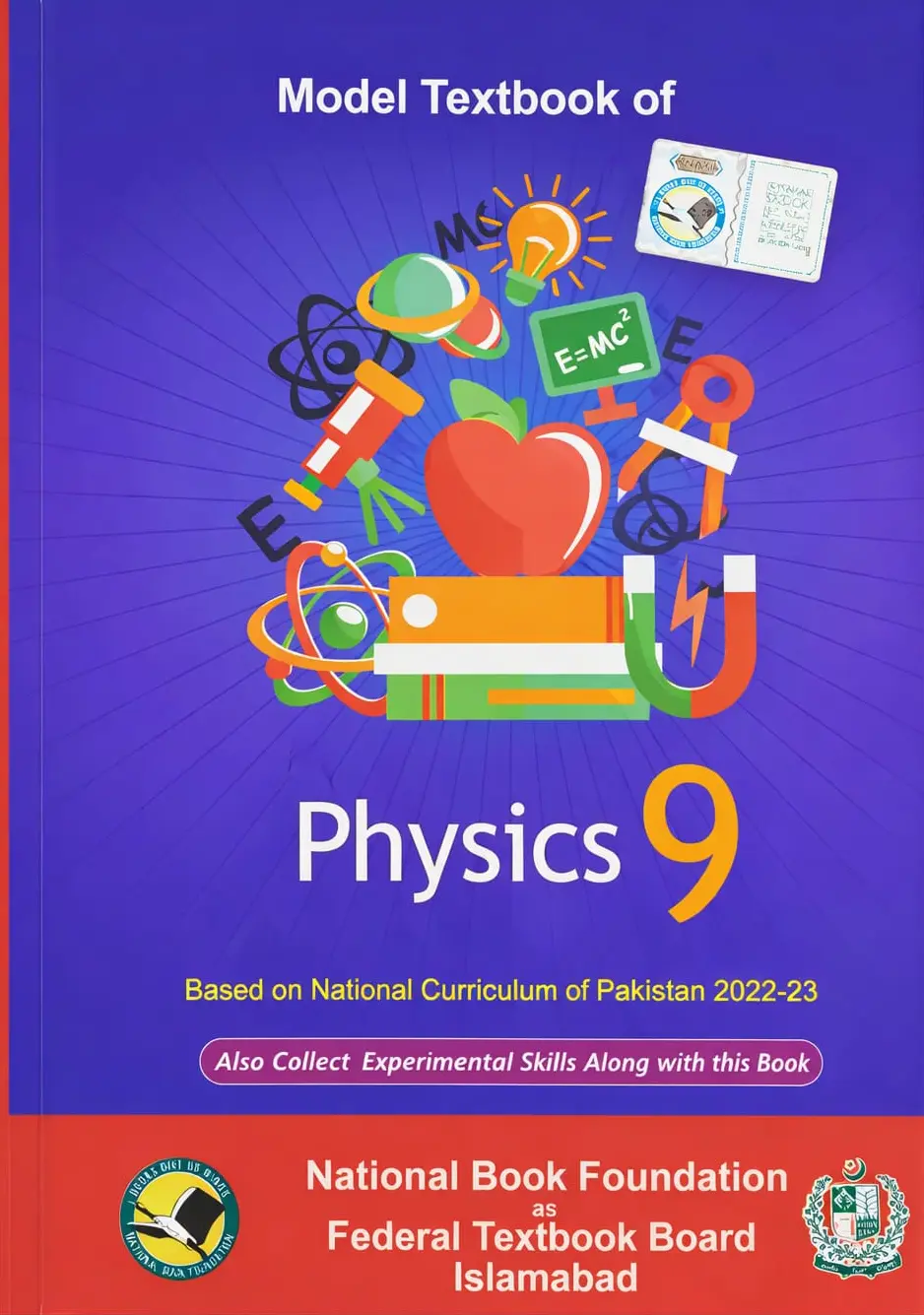
Welcome to PrimeStudy's Class 9 Physics notes, built around the NBF
textbook for the 2026-2027 FBISE session. Aligned with the National
Curriculum of Pakistan and the SLO framework, these notes cover all
nine chapters — from physical quantities and measurement through to
magnetism — with chapter-wise explanations, solved MCQs, fully worked
numericals, and exam-oriented short and long questions.
Physics builds the scientific thinking students carry into Classes 11
and 12, and it's foundational for anyone heading toward engineering,
medicine, or IT later on. Because it's such a numerical-heavy subject,
every chapter here walks through the formula, the substitution and the
final answer — not just the answer on its own — so you can see exactly
how marks are earned under the FBISE marking scheme.
What's included in every chapter
- Solved Exercises — complete answers to every textbook review question and activity.
- MCQs — multiple choice questions with correct options and explanations.
- Numericals — step-by-step worked solutions showing formula, substitution and final answer.
- Short Questions — concise, exam-focused answers matching board requirements.
- Long Questions — full derivations and detailed explanations for high-scoring answers.
- Definitions — clear meanings of key physics terms and quantities.
- Diagrams — free-body diagrams, motion graphs, and magnetic field lines, which come up often in board papers.
- PDF Download — offline access to complete notes for on-the-go revision.
How to prepare Class 9 Physics from these notes
- Read the textbook chapter first to get the basic context before the solved notes.
- Learn the formulas for that chapter — physics marks are lost fastest when a formula is misremembered.
- Solve the MCQs to prepare for Section A of the FBISE board exam.
- Work through the numericals yourself before checking the solved steps.
- Practice short questions, focusing on the keywords examiners look for.
- Study the long questions and derivations until you can reproduce them without notes.
- Practice the diagrams — free-body diagrams, motion graphs and magnetic field lines are frequently tested.
- Revise before tests and exams using the PDF notes to keep concepts fresh.
SNC & SLO Alignment
These notes are fully aligned with the National Curriculum of Pakistan
and the Student Learning Outcomes (SLO) framework set by the Federal
Board (FBISE), based on the National Book Foundation (NBF) textbook for
the 2026-2027 session.
Related Resources
Continue your Class 9 exam prep with our other FBISE subject notes:
Frequently Asked Questions
What topics are covered in Chapter 1: Physical Quantities and Measurement?
Chapter 1 covers the branches of physics, physical and non-physical quantities, SI base and derived units, scientific notation and prefixes, scalars and vectors, measuring instruments such as the vernier caliper, screw gauge and stopwatch, and significant figures.
Does Class 9 Physics cover Newton's Laws of Motion?
Yes — Chapter 3 (Dynamics I) covers Newton's First, Second and Third Laws of Motion along with their limitations, mass vs weight, gravitational field, and momentum including impulse and conservation of momentum.
What does the Work and Energy chapter include?
Chapter 6 covers work, kinetic and potential energy, energy conversion and conservation, major energy resources such as solar, hydro, wind and fossil fuels, power, and efficiency.
What is covered in the Magnetism chapter?
Chapter 8 covers the domain theory of magnetism, the magnetic field of a bar magnet, methods of inducing magnetism, diamagnetic, paramagnetic and ferromagnetic materials, and Earth's magnetic field.
Are the numerical problems solved step by step?
Yes, every chapter includes fully worked numericals showing the formula, substitution and final answer, matching the FBISE marking scheme.
How many chapters are in the Class 9 Physics NBF book?
There are nine chapters: Physical Quantities and Measurement, Kinematics, Dynamics I, Dynamics II, Pressure and Deformation in Solids, Work and Energy, Density and Temperature, Magnetism, and Nature of Science and Physics.
Can I download these notes as a PDF?
Yes, each chapter has a free PDF download link so you can study offline.
This content is provided for educational support only and is not for
sale, redistribution, or commercial use. PrimeStudy does not claim
ownership of any government textbook material.